Showing posts with label prediction. Show all posts

Wednesday, October 5, 2011

Apple Siri. The Butlers are coming

Siri
Web2.0 democritised e-publishing and data creation in a friendly way for the masses and low and behold there are 182 million websites available on the net in 2011. Some of these websites have the lions share of the content (Facebook, Flickr, Google, Amazon etc) but collectively it's a grand publish of human thoughts, artefacts, wishes and desires.  What a wonder!

Creating content is one thing but leveraging insights across the content is more difficult. In truth there is still too much information for humans to effectively use and we find ourselves to be a gear in the machine rather than the driver - connecting systems together, cutting, pasting and rekeying.

I want to ask simple questions of my computers and have powerful background processing bring me the answer. Questions like "Which famous guitarists endorse products but don't use them in their live shows?" A query like this would require text analysis of the question to understand the meaning, scouring the net for famous guitarists,  checking which brands they claim to use in endorsements, checking their live 'kit' on websites, picture recognition of what guitars they are using, comparison of statements versus reality and then provide a weighted response based on the volume of data processed. Not easy and lots of key tapping.

Voice Control on the Bat Computer
It won't always be this way.

Batmans computer has been serving him for years (in the fictional world of DC Comics) controlled by his voice helping him fight crime. He simply asks the computer a question while he is driving or smashing heads of supervillans together and his Batcomputer gets back to him with the summary. Questions like  "Cross reference the known toxins that the Joker uses with chemical factories in the vicinity of Posion Ivy's locations over the past three months" are answered with ease. If a clarification is needed then it asks Batman. All achieved using natural language as the interface.

Digital buddies, assistants and advisors are here already for consumers albeit in the form mostly of recommendations engines and advertising systems. Last.fm helps reduce the millions of bands down to something I might like based on my previous listening while Amazon  advises me of books and products I might enjoy based on my previous activity.

These systems help us save time and slash the options and possibilities down to something we can handle. The volume of data falls below our eye and we can concentrate on the richer questions and answers.

For me the biggest aspect of the new iPhone 4S release was Siri - the virtual assistant. I think that as innocuous as it might appear on the surface (fixing calendars, looking up the weather, setting reminders) it is one of the first believable assistants that interact with consumers in a rich way.


Over time this service will grow to understand your accent, tone of voice and mood. It might voluntarily ask you what's wrong or question your commands if it thinks you are acting irrationally. It will potentially develop it's own personality and it will be answering more and more complex queries. Multiple Siris may even communicate and negotiate with one another to save their 'owners' from corresponding back and forth needlessly. Young children that can't type and older people may begin interacting with computers in richer ways. Siri may begin to find it's way into robots and other household devices outside of mobiles.

It's exciting and this is only the beginning. Others have tried to provide this kind of service but none have had the design and user base that Apple have in order to make it 'stick'.

I'll be watching this one carefully.


Friday, December 12, 2008

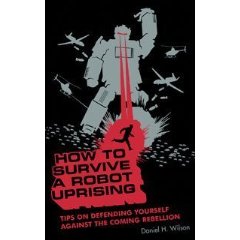
Hunting Robots and How to Survive a Robot Uprising


The Pentagon recently announced that they want suppliers to provide a "Multi-Robot Pursuit System" that will let packs of robots "search for and detect a non-cooperative human".


I recommend boning up on robot pursuit avoidance now. How to Survive a Robot Uprising is the book you need. You'll read it in an hour and it may save your life one day or at least give you suggestions on how to get your leg out of an annoyed hoover.


Thursday, April 10, 2008

The Prediction Model

I've become increasingly interested in the overlap of biology and computing over the past few years. It began with the realisation that the web and stock market are really biologic in nature with their fault tolerance, nodal shape, replication of information and distributed locus of control and was further prompted by work I undertook on AI systems for Advertising and Social Computing solutions.

I’m enjoying this overlap developing into a moderate obsession and I am trying to steer my thinking on all things computing into a more ‘biologic fashion’. I’ve always been a strong believer that people involved in one discipline can offer fresh insights on other sciences and that a good set of ‘first principals’ can work well cross domain. This cross pollination was the grease that helped the machine of the Industrial Revolution into being and obliquely it’s also the reason I give for sporting sideburns like some Manchester factory owner.

This post is inspired by Jeff Hawkins who is doing work into models of the brain and attempting to derive an overarching theory of the brain which is something that, despite the reams of data we have on the brain, we are as yet unable to articulate. His talk was on the use of a Prediction Model as the primary approach to developing a theory of the brain and he got my mind racing.

After graduating from Cornell in June 1979 he read a special issue of Scientific American on the brain. In it Francis Crick lamented the lack of a grand theory explaining how the brain functions.[3] Initially, he attempted to start a new department on the subject at his employer Intel, but was refused. He also unsuccessfully attempted to join the MIT AI Lab. He eventually decided he would try to find success in the computer industry and then try to use it to support his serious work on brains, as described in his book On Intelligence

Jeff thinks that the reason we still haven’t managed to define intelligence well is that we don’t have this overarching theory of the brain or more accurately – intelligence. Jeff postulates that the brain isn't like a powerful computer processor and that instead it’s more like a memory system that records everything we experience and helps us predict, intelligently, what will happen next.

Things like these stop me sleeping at night and last Sunday I leaned over to my girlfriend at 2am and whispered to her “I have to write some stuff”.

I slipped out of bed and knocked up the notes below. They are presented here un-edited and what you see is the first pass brain dump of some of my thoughts and concepts surrounding a Prediction Model (It's probably best to click on one and open up the set in Flickr and view from there).

If you are involved in this area at all I would love to hear from you as I intend to delve deeper. Physics has alot to add to this area with work in quantum theory and calculations surrounding boundaries of event horizons for black holes all being of relevance to the model of the brain and prediction.


06/04/2008

06/04/2008

06/04/2008

06/04/2008

06/04/2008

06/04/2008