Wednesday, March 19, 2008

Photosynth and how the 'collective image memory' is harversted

We're building a collective digital memory with all those:
  • votes and ratings
  • comments and blogs
  • tags and bookmarks

We can put this data on google maps, and provide strong links between place and time as well as invent applications that use this data to create new environments. We don't even need to use the common map metaphor to see our data with IBM's wonderful tool 'Many Eyes' which allows us to analyse data in interactive graphs and visualistions. Data can be processed by simple XML allowing for automated feeds of information and graphic representation such as the example below:


And then there is some next level image-onomy or whatever new paradigm term we need to invent that Photosynth ushers in. A technology acquired by Microsoft and originally developed by Blaise Aguera y Arcas.

It allows a feed of photos to build up a map of the earth and places not just using flyover images by aeroplanes or satellite data but by using our own photographs and even illustrations. Photosynth uses public images and it doesn't matter whether these photos are taken by a £10 disposable camera or a posh SLR - it can stitch them together and produce a never ending tapestry that allows you to move around geographic areas and locations with ease.

With Photosynth you can:

  • Walk or fly through a scene to see photos from any angle.
  • Seamlessly zoom in or out of a photo whether it's megapixels or gigapixels in size.
  • See where pictures were taken in relation to one another.
  • Find similar photos to the one you're currently viewing.
  • Send a collection - or a particular view of one - to a friend.
Zooming in might have you moving through 10 photos using your own as a starting point. Your landscape shot of the fair ex-mining town of Cowdenbeath on your digital camera might be part of a family of 1000 photos of Cowdenbeath. Using this pool of images like stones in the middle of a pond you can step and zoom in deeper and deeper to find the Forth Road Bridge in detail when it was just a red spec on your own photo.

Photosynth takes data from everyone - from the collective memory of what the world looks like. A model emerges of the entire earth as our own photos get tagged with other peoples metadata and the mesh of linking becomes tighter and stronger. The network effect continually enriches the space and easily provides cross user and cross model experiences and information.

This is the real semantic web or 'Web3.0' along with the Social Graph developing through the use of people networks. These inferences are taking a life of their own and one can only wonder at what Web5.0 might be.

There's a great demo hosted by TED where Blaise runs through the application with jaw dropping effect.

Photosynth modestly state "Our software takes a large collection of photos of a place or an object, analyzes them for similarities, and displays them in a reconstructed three-dimensional space."

This experience is on the web to try right now but be warned Mac fans - this web experience is PC only for now.

Monday, March 3, 2008

Cheap Ideas for advancing Biologic Computing

One of the biggest problems in Biologic Computing today is the predictability of bacterium's movements...

How about this simple, relatively cheap project a cross functional team might be able to do at a University...

- Get feeds from the IBM public visualisation tool - specifically pictures of datasets. They can be Social Network activity feeds (or hub/colony'esque data). Here's one of many examples
- Grab the visualisations of them as well as the raw data
- Run some visual pattern matching software to compare these images against bacterium imagery - at varying scales of magnification
- Do the same pattern matching on the numbers
- See if anything interesting pops up in the pattern matching

Developing continually running real world feeds (API's/RSS or otherwise) from these types of public systems to visual biology computing resources would be potentially useful.

Their benefit is that they are
- continually updated, for free, and have simple XML descriptions of data.
- a constant public feed allow large elements of automation in such a project (bar the human analysis of 'matches' by the system)
- non-proprietary in nature and will 'out', in the end, for generating useful patterns vs custom expensive data capture

If you are up to stuff like this then I'd love to know about it. Mail me.

Recommended Reading: "Genesis Machines" by Martyn Amos


Plea's to the Machine - a Crash Report


Thursday, February 28, 2008

Nokia Morph - new nanotech concept video of future devices

Morph is a concept demonstrating some of the possibilities nanotechnologies might enable in future communication devices. Morph can sense its environment, is energy harvesting and self cleaning. Morph is a flexible two-piece device that can adapt its shape to different use modes. Nanotechnology enables to have adaptive materials yet rigid forms on demand. It is also featured in the MoMA online exhibition "Design and the Elastic Mind". It has been a collaboration project of Nokia Research Center and Cambridge Nanoscience Center.


Find out more: Morph

Wednesday, February 27, 2008

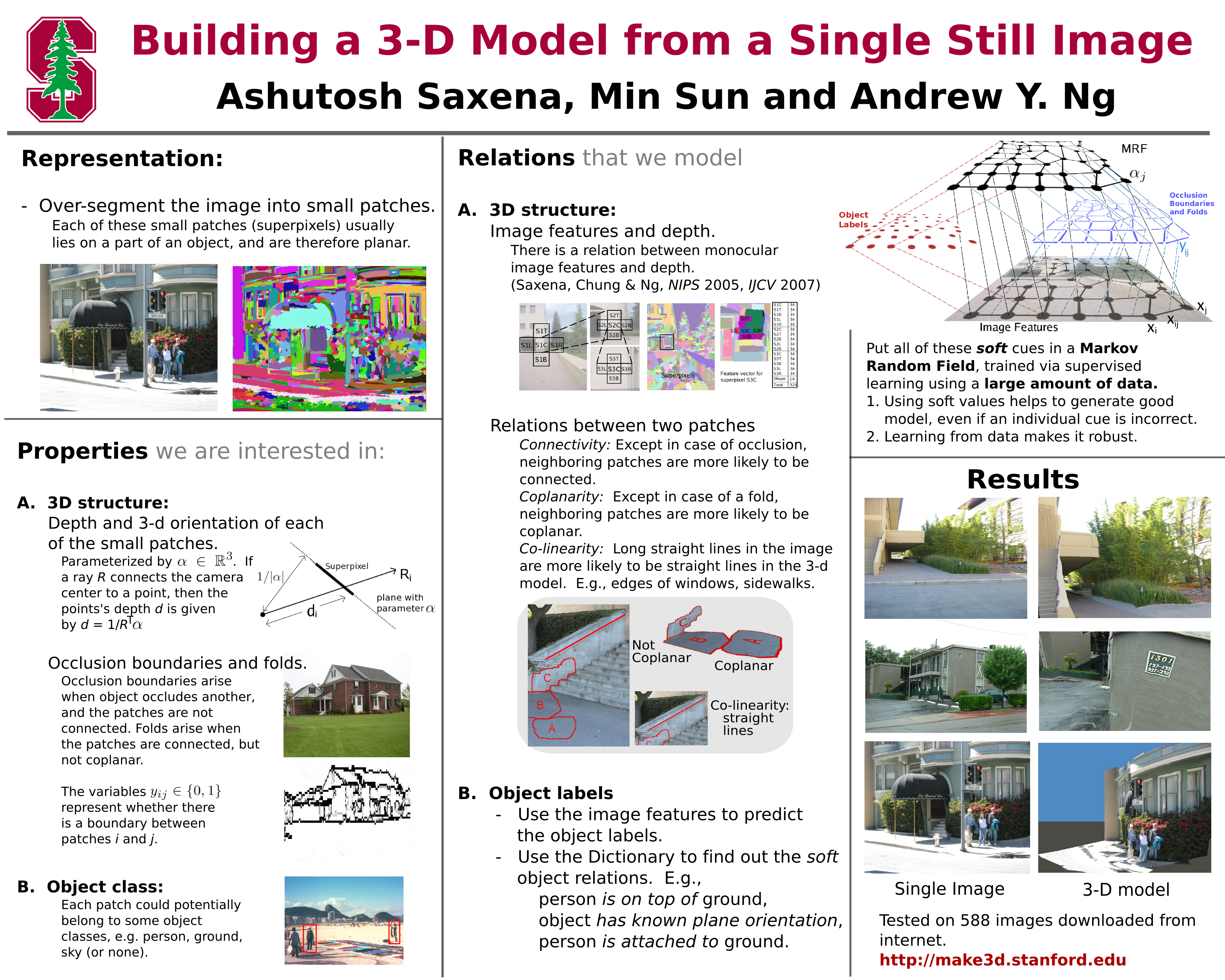
Stanford's Make3D - 3D flythroughs from a single 2D image

Make3D is a project from two Stanford students that won a 'best paper' award at the International Conference on Computer Vision in Rio de Janeiro in October 2007.

The online service takes a 2D image and creates a 3D'esque fly around models that include depth and a range views. Photos can be uploaded directly or pulled into the site from Flickr - however the service requires that you rate at least five images before you can pull them in from Flickr. You can jump in and just use the upload from hard drive option though

Click through to this link to see an example of it in action from a photo I took in Egypt at the pyramids:


Note: it doesn't work for Intel Mac and Shockwave but there is a workaround for installing a VRML viewer for Linux which will be given to you as an option.

The tech lowdown on the algorithm from January Stanford News Service :

…the algorithm breaks the image up into tiny planes called “superpixels,” which are within the image and have very uniform color, brightness and other attributes. By looking at a superpixel in concert with its neighbors, analyzing changes such as gradations of texture, the algorithm makes a judgment about how far it is from the viewer and what its orientation in space is. Unlike some previous algorithms, the Stanford one can account for planes at any angle, not just horizontal or vertical. This allows it to create models for scenes that have planes at many orientations, such as the curved branches of trees or the slopes of mountains.

An excellent diagram on the process can be found here.

This is one of the first web services of this ilk out of the starting gate. Microsoft have had Photosynth for a while but instead of using one image to derive the model it meshes together multiple images.

Monday, February 25, 2008

Don't Click It

http://www.dontclick.it/


This is a great little project that allows you to navigate and do your web business without ever having to click on bit of the virtual screen. Although a little migraine inducing as the screens change constantly it is actually quite simple to use.

Contextual actions for such an interface (normally provided by right mouse click) will have to be programmed in from the beginning as part of the UI. A pretty big plus is the removal of tendon damage from all the inane clicking we do.

Another aspect of this type of interface is that with a simple projector and a flat surface (i.e. a desk) you could even use your finger OR a stick to move around the virtual space and options.

I dig (single g) it.

Monday, February 18, 2008

Speaking Freely

"You are currently studying user generated content and I'm not obsessed with the fact about trying to become the next ___."

spoken through SpinVox


What was actually said:

"We are currently studying User Generated Content and we're not obsessed with trying to become the next Facebook"